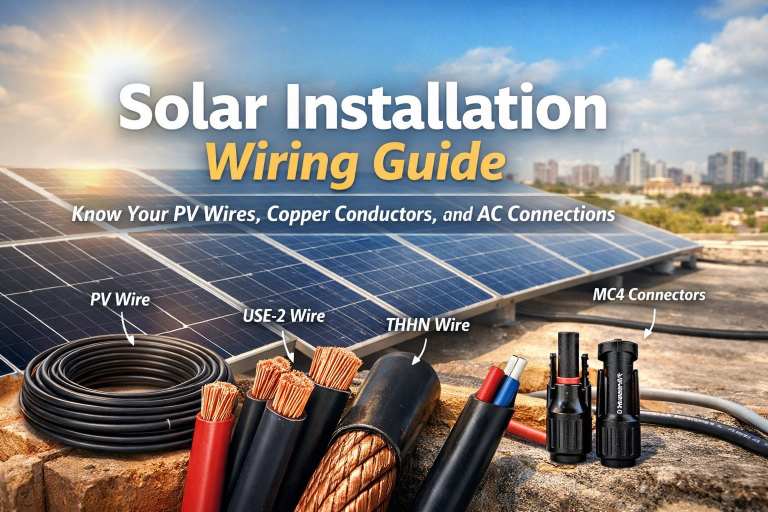
When people think about going solar, most of the attention goes to the panels. How many kilowatts will they produce? How fast will the system pay for itself? How much will it cut the electricity bill? These are fair questions. But there is a part of every solar system that rarely gets talked about, and it matters just as much as the panels themselves. The wiring.
Every solar system runs on a network of cables and wires. They carry power from the panels to the inverter, and from the inverter to your home. If those wires are the wrong type, the wrong size, or just plain cheap, the whole system suffers. You get power losses, overheating, and in bad cases, fire.For anyone planning solar PV installations in Pakistan, knowing what wires go where is not just useful background knowledge. It helps you ask the right questions, spot cheap shortcuts, and make sure you are getting what you are paying for.
Why Wiring Deserves More Attention Than It Gets
Solar panels generate direct current (DC). That power travels through wires to an inverter, which converts it into alternating current (AC) that your appliances can use. Every part of that journey needs wires built for the job.
The problem is that wiring is invisible once the installation is done. Nobody sees it. Nobody photographs it for Instagram. So some installers use the cheapest cables they can find, knowing most homeowners will never notice.
In Karachi specifically, this is a serious issue. Rooftops here get punishing sun. Temperatures hit 45°C in summer. There is coastal humidity, salt in the air, and UV levels that will destroy cheap insulation within a couple of years. If you are looking at a residential solar installation in Karachi, the wiring spec matters more than most people realise.
PV Wire (Main Wire for Solar Panel DC Wiring)
PV wire is the cable specifically made for solar systems. It runs from the panels, across the rooftop, and into the inverter or combiner box. Everything on the DC side of the panels uses PV wire. It meets the UL 4703 standard, which means it has been tested for the exact conditions a solar system faces.
What makes PV wire the right choice for solar panel DC wiring:
It is rated for up to 1000V DC, which covers the voltage range of most residential and commercial systems. The insulation is cross-linked polyethylene (XLPE), which handles temperatures up to 90°C in wet conditions and 105°C when dry. The outer jacket is sunlight resistant and does not crack or go brittle after years on a rooftop.
For solar installation in Karachi, PV wire is not a premium upgrade. It is the baseline. Any exposed cable on a Karachi rooftop that does not have proper UV and heat resistance will start failing within a few years.
Copper Wires
Inside every quality solar cable, the conductor is copper. Copper wires are the industry standard for solar PV installations. The reason is straightforward. Copper conducts electricity better than almost any other material, and in a solar system, good conductivity directly affects how much power actually reaches your home.
When current flows through a wire, some energy is lost as heat due to resistance. The better the conductor, the less energy is wasted. Copper keeps those losses low. It also handles heat well, which matters in a system where cables can sit in the sun for hours every day.
Why copper wires are the right call for every solar installation:
Copper has low electrical resistance, which means less energy lost over long cable runs. It can carry a high current for its size. It does not corrode easily, so it holds up for decades. Connectors and terminals are designed around copper, so compatibility is never a problem. And in Pakistan, copper wire is widely available, so there is no excuse for substituting something worse.
Some cheaper packages use aluminium conductors. Aluminium is not dangerous on its own, but it needs a bigger cable for the same current, it oxidises more at connection points, and it does not work well with standard solar connectors. If you are building a proper solar energy system for your home, copper wires throughout is the only sensible choice.
USE-2 Wire (When Cables Need to Go Underground)
USE-2 stands for Underground Service Entrance, 2nd edition. It is moisture resistant, buried cable rated and sunlight resistant. In solar systems, it is used when cables need to travel underground, typically in ground-mounted arrays or when the rooftop array is far from the inverter and the cable run needs to go through the ground.
You will often see PV wire and USE-2 sold together as a combined PV/USE-2 cable. They share similar insulation specs and are approved for the same uses in most cases. For large commercial solar PV installations where trenching is involved, USE-2 or a PV/USE-2 combination is the standard specification.
You can see how these cable runs are handled across different project scales on our completed projects page.
THHN Wire (The Right Choice for Solar Inverter AC Wiring)
Once the inverter converts DC power to AC, the wiring requirements change completely. The DC cables from the panels give way to AC cables going from the inverter to your distribution board. This is where THHN wire comes in.
THHN stands for Thermoplastic High Heat-resistant Nylon-coated. It is the standard wire for solar inverter AC wiring. It is rated for 90°C in dry conditions and 75°C in wet conditions. The nylon outer jacket makes it tough enough to pull through conduit without damaging the insulation.
THHN wire is always run inside conduit indoors and in rooftop areas. It is not rated for direct sun exposure without protection. A good solar installer in Karachi will never leave THHN wire sitting in open sunlight. It goes in conduit, and the conduit protects it.
For higher-spec systems, THWN-2 wire is sometimes used instead. It is rated for 90°C in both wet and dry conditions, which gives more headroom in demanding environments.
If you want to understand where THHN wire fits into the full installation sequence, take a look at how we work through every stage of a project.
UV Resistant Solar Wire
Any wire sitting in direct sunlight needs UV resistant solar wire. UV radiation breaks down plastic and rubber insulation over time. The insulation cracks. It goes brittle. Eventually it fails completely and leaves live conductors exposed.
In Karachi, the UV index is high for most of the year and reaches extreme levels from April through September. Cheap cables with standard insulation will degrade within two to three years on a Karachi rooftop.
Genuine PV wire is already UV resistant by design. But any other cable on the rooftop that is not inside conduit also needs to have a UV resistant rating. This includes any additional DC runs and cable management assemblies.
Checking your cables for UV degradation is also a key part of long-term system care. Damaged insulation is one of the most common causes of performance loss that goes unnoticed until something fails. Read more about how to maintain solar panels to understand what to look for and how often.
MC4 Connector Cables
MC4 connectors are the plug-and-socket assemblies that link solar panels together. They are not a wire type on their own, but they are pre-attached to short cable sections that form the inter-panel connections in every solar string.
MC4 connectors are weather sealed, UV resistant, and made for outdoor use. They click together and lock, so the connections stay secure even in wind and rain. The problem is the market is full of counterfeit MC4 connectors that look identical to genuine ones but fail much faster. Fake MC4 connectors are one of the leading causes of arcing faults in solar systems.
Always ask your installer what brand of MC4 connectors they use. Reputable brands include Staubli, Amphenol, and a small number of certified equivalents. Before choosing an installer, it is worth checking out a comparison of the top solar companies in Karachi to see how they approach component quality.
How the Mounting Structure Affects Wiring
Wires do not just float in the air. They run alongside and through the panel mounting structure, clipped into cable management channels and routed through the frame. A well-designed solar structure installation includes proper routing paths that keep cables away from sharp edges, prevent abrasion, allow airflow under panels, and stop cables from flapping in the wind.
A poor structure with no thought given to cable management will damage even good quality UV resistant solar wire over time. The cable gets pinched, rubbed against metal, or held against the hot roof surface. It is a slow failure that builds up over years.
Getting the Wire Size Right
Wire type is only part of the picture. Size matters too. An undersized wire runs hot under load, which degrades the insulation and wastes energy. An oversized wire costs more without adding any real benefit.
Wire sizing depends on the short-circuit current of the panels, the total string current, the length of the cable run, the ambient temperature, and whether the cable is in conduit, open air, or a cable tray. Longer runs need bigger cables to keep voltage drop within acceptable limits.
For most residential systems in Pakistan, the DC wiring uses 4mm² or 6mm² copper PV wire. The AC wiring gauge is matched to the inverter’s output current. Any reputable installer should give you a wire sizing calculation as part of the design, not just a panel count and a price.
Quick Reference: Wire Types in a Solar System
- PV Wire is used for solar panel DC wiring and all exposed rooftop cable runs. It is UV resistant and heat rated for outdoor solar use.
- Copper Wire is the conductor inside all quality solar cables. It keeps resistance low and performance high over the life of the system.
- USE-2 Wire handles underground DC runs in ground-mounted systems or long cable routes that go through trenches.
- THHN Wire covers solar inverter AC wiring inside conduit from the inverter to the distribution board.
- UV Resistant Solar Wire is required for any exposed cable on the rooftop that is not protected by conduit.
- MC4 Connector Cables are the short inter-panel connections that link panels in strings.
What This Means for Homeowners in Karachi
The wiring in your solar system affects how much power you get, how safe the system is, and how long it lasts. None of that is visible once the panels are up. So the only protection you have is asking the right questions before the job starts.
Ask your installer what type of wire they are using on the DC side. Ask about the UV rating of any exposed cables. Ask what brand of MC4 connectors they specify. Ask to see a wire sizing calculation. A good installer will answer all of this without hesitation.
Our commitment to sustainability means that every installation we do uses proper PV wire, genuine copper wires, correctly rated THHN wire on the AC side, and fully UV resistant solar wire wherever cables are exposed. No shortcuts.
And after your system is installed, having access to reliable solar maintenance services in Karachi means any early signs of cable degradation get caught before they turn into bigger problems.
Good wiring, done properly from day one, is what gives a solar system its full 25-year lifespan. It is not the part of the system anyone talks about. But it is the part that holds everything together.